
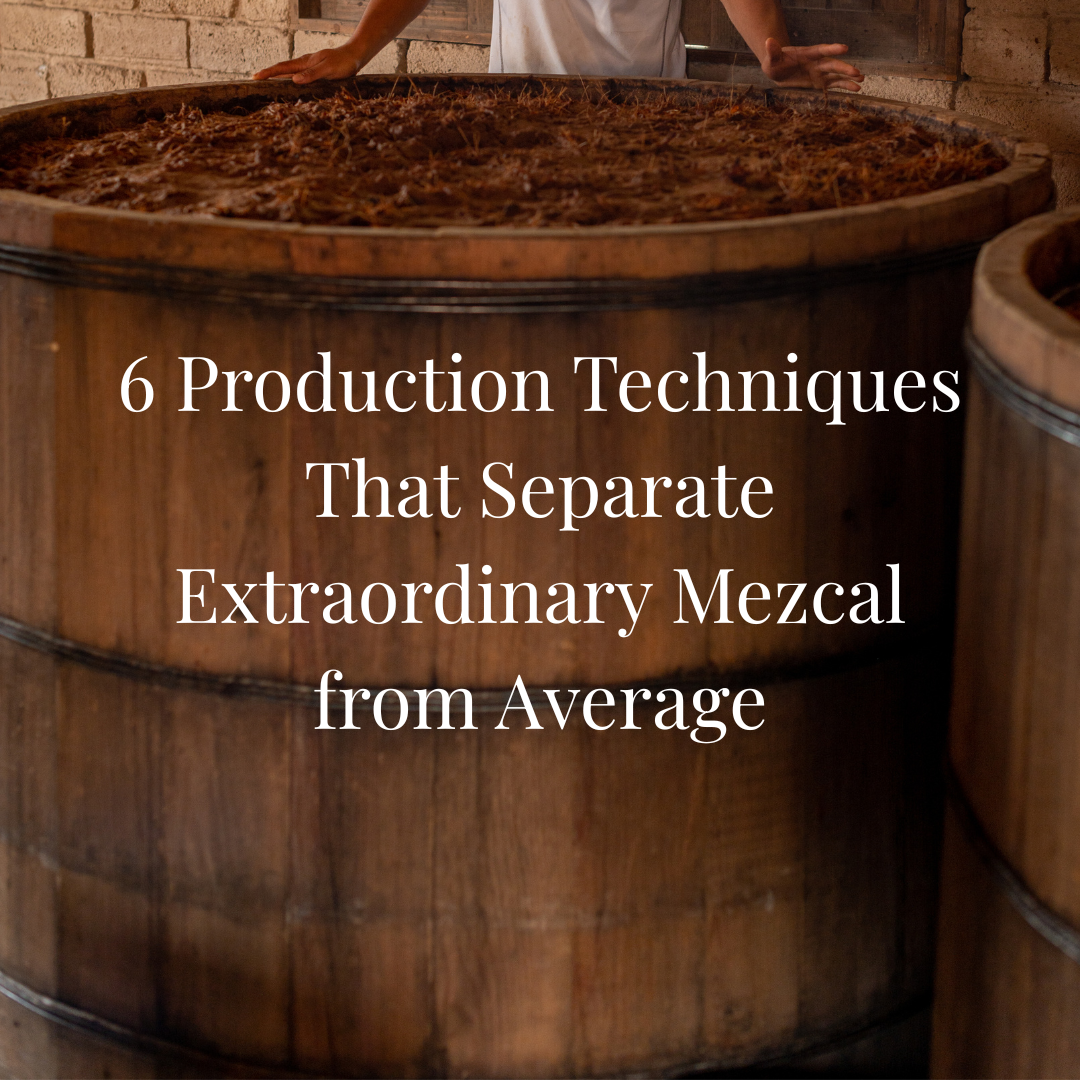
Walk into any well-stocked spirits shop today and you will find more mezcal than you would have imagined possible ten years ago. Some of those bottles deserve every penny on their price tag. Others do not. The difference rarely lives in the label design, the celebrity name on the back panel, or the origin story printed in small type. It lives in the decisions made across months and years of production: how the agave was grown, how it was cooked, how it was crushed, and how it was fermented and distilled. These are the choices that determine whether a mezcal becomes something worth hunting down or something you finish out of obligation. Six of those choices stand above the rest.
1. Agave Species and Harvest Maturity
The foundation of any mezcal is the agave itself, and the species in the bottle shapes everything downstream. NOM 070, the Mexican standard that governs mezcal production, permits a long list of agave species. Espadin (Agave angustifolia) dominates commercial production because it is widely cultivated and reaches maturity in seven to nine years. That relative speed, combined with reliable sugar content, makes it the workhorse of the category. There is nothing wrong with espadin mezcal made well. There is also nothing remarkable about espadin mezcal made carelessly.
Maturity matters as much as species. An espadin harvested prematurely, before the quiote (the towering flowering stalk) has emerged and the plant signals it has completed its growth cycle, yields lower sugar concentrations and thinner flavor. Patient producers wait. The sugars are fully developed in the piña, the heart of the plant, only at the end of its natural cycle.
Move into wild-harvested species and the stakes become considerably higher. Wild tobala (Agave potatorum) can take 15 to 25 years to reach maturity in the mountains of Oaxaca. Tepextate (Agave marmorata) is commonly quoted at 25 to 35 years. These plants cannot be cultivated at any meaningful scale, so every bottle represents a one-time harvest from a specific plant in a specific place. The complexity those long-lived plants deliver in the glass is inseparable from decades of slow growth in rocky volcanic soil with minimal rainfall. When producers harvest wild species before full maturity to satisfy demand, no amount of skilled distillation covers for it.
2. Roasting Method and Wood Selection
Most people associate mezcal with smoke, and that smoke originates here, in the underground earthen pit where roasted agave piñas cook before fermentation begins. The pit is lined with volcanic rocks heated by a wood fire at its base. Once those rocks reach temperature, the quartered or whole piñas are layered in with additional rocks and organic material, and the pit is sealed with soil and canvas for three to five days.
The type of wood is a variable many drinkers overlook entirely. Mesquite burns hotter and delivers a more aggressive, resinous smoke. Oak produces a cleaner, more restrained profile. Producers in different regions use whatever grows locally, which is part of why a mezcal from San Luis Potosi often tastes fundamentally different from one produced in Oaxaca even when both are made from the same agave species. The depth of the pit, the density of the volcanic rocks, the moisture level of the piñas at the time of roasting, and the duration of the cook all shape how much smoke penetrates the piña and how thoroughly its starches convert to fermentable sugars.
The alternative, autoclave or above-ground oven cooking, eliminates nearly all of the smoke. These methods are standard in industrial production and yield a cleaner spirit. For mezcal specifically, the pit roast is not incidental. It is part of the tradition and the flavor profile the category is built on.
3. Milling: How the Piñas Are Crushed
After roasting, the piñas must be broken down so their sugars are accessible during fermentation. The crushing method shapes not only efficiency but flavor. The tahona is a large stone wheel, often weighing a ton or more, traditionally pulled around a circular stone pit by a horse or burro. The process is slow and labor-intensive. It bruises the fibers rather than shredding them, leaving longer strands of agave material that remain in the fermentation vessel alongside the juice. The resulting spirit tends toward greater textural richness and a distinctive mineral quality.
Mechanical shredders, called desgarradoras, work faster and more consistently. The extraction is more efficient, but the aggressive mechanical action generates heat and can oxidize certain volatile compounds before fermentation even begins. Many producers argue that this flattens the aromatic complexity of the final spirit.
In some communities, hand-mashing with wooden mallets remains the standard. It is the most time-consuming approach and is still practiced in villages where mechanization was never adopted. The resulting texture in the fermentation vessel tends to be coarser, and the spirits that come from these producers often carry a raw, direct quality that resists easy imitation.
4. Fermentation: Vessels, Yeasts, and Time
Fermentation may be the single most complex variable in mezcal production. Rather than commercially cultured yeast strains, traditional mezcal fermentation relies on wild ambient yeasts from the air, the producer’s hands, the walls of the fermentation vessel, and the agave’s own skin. This makes the process slower and less predictable. It also means each batch absorbs something of its specific environment, which is a large part of why mezcal made in the same village from the same species can taste meaningfully different depending on who made it and when.
The fermentation vessel matters. Open pine or sabino (Mexican cypress) vats are common in Oaxaca and contribute their own microbial populations to the developing ferment. Some producers use stone or clay. In certain communities in Guerrero and Oaxaca, fermentation in cowhide or goat skin remains the traditional approach. Each material introduces a distinct microbial community and behaves differently across seasons.
The decision about bagasse, the fibrous material remaining after pressing, also shapes the final spirit. Producers who ferment with the fiber intact allow additional flavor compounds to continue developing as the fibers break down over the fermentation period. Spirits made this way typically show more texture and a wider range of secondary flavors than those where the fiber was removed before fermentation.
Fermentation time varies from as few as five days in warm weather to thirty days or more in cooler highland conditions. Rushing fermentation by adding heat or commercial yeast truncates the development of flavor compounds that only emerge over time. The best producers let each batch complete on its own schedule.
5. Distillation Vessel and the Art of the Cut
Copper pot stills are the most common distillation vessel in mezcal production and valued for the way copper reacts with sulfur compounds in the distillate, producing a cleaner spirit. The shape, size, and age of the still influence the final product in ways that are subtle but real.
But copper is not the only option, and for some of the most distinctive mezcals produced anywhere, it is not the preferred one. Clay pot distillation using ollas de barro remains the traditional method in Santa Catarina Minas, a small village in the Canadas region of Oaxaca. The porous clay reacts with the distillate differently than copper and produces a spirit with an earthy, mineral character that no copper still can replicate. These are mezcals that exist in a category largely their own.
In the vast majority of mezcal production, distillation happens twice. The first pass produces ordinario, a rough intermediate spirit at low proof. The second pass refines the spirit and raises the proof. Where the maestro mezcalero makes cuts between the head, the heart, and the tail of the distillate is one of the most consequential skill-based decisions in the entire production process. An aggressive cut that retains too much of the head produces a harsh, solvent-forward spirit. A timid cut that keeps too much tail creates something heavy and coarse. Getting it right requires years of sensory experience and acute attention to each batch as conditions change.
Pechuga deserves mention here as one of the most celebrated expressions in the category. A third distillation in which raw proteins, typically a chicken or turkey breast, are suspended in the still alongside seasonal fruits and spices, pechuga mezcals carry a silky, rounded texture attributed to the proteins interacting with the distillate during that final pass. Traditionally made for Dia de los Muertos and other celebrations, they represent the category at its most intentional and community-rooted.
6. Water Source and Proofing
Water enters mezcal production at two critical points: fermentation and proofing. Both are underappreciated by most consumers and, in some cases, by producers as well.
Fermentation requires water to dilute the cooked agave must down to a concentration where yeasts can work effectively. The mineral profile of that water, its levels of calcium, magnesium, and bicarbonate, directly affects yeast activity and which flavor compounds are produced as a result. Producers working in areas with naturally mineral-rich spring or well water from limestone-rich geology are working with a built-in advantage that cannot be relocated.
Proofing, the addition of water to bring the distillate down to bottling strength, requires the same care. Using chlorinated tap water to cut a traditionally made mezcal is the production equivalent of serving an extraordinary spirit in an unwashed glass. The best producers use the same spring or well water that fed the fermentation, maintaining consistency from mash to bottle.
Many traditional mezcals are bottled at the natural proof that comes off the still, without any dilution at all. These expressions deliver the full intensity of what the maestro intended. When you see an ABV labeled at something unconventional like 47.3% or 51.8%, that is not a marketing decision. That is the proof the spirit came off the still, left exactly as it was.
Understanding these six elements will not make you a maestro mezcalero. But it will make you a sharper consumer and a more informed advocate for the producers doing the work the right way. The next time you open a bottle, the story behind it stretches back years, sometimes decades, to the moment an agave plant took root in rocky volcanic soil. Every decision between that field and your glass shaped what you are tasting. Recognizing those decisions, and choosing to support the producers who make them with care, is the most direct thing any of us can do to keep extraordinary mezcal alive.