
Ask ten people at a bar what the difference is between tequila and mezcal and you will get ten different answers, most of them wrong. The most persistent myth is the simplest: that mezcal is just smoky tequila, or that tequila is a kind of mezcal. Neither is quite right. Both spirits share a common ancestor in the agave plant and a common homeland in Mexico, but the regulations, traditions, and sensory profiles that define each category diverge in ways that matter enormously once you start paying attention.
These are not trivial distinctions. Understanding them changes how you shop, how you taste, and how you talk about what is in your glass. Here are seven differences worth mastering.
1. The Agave Plant Itself
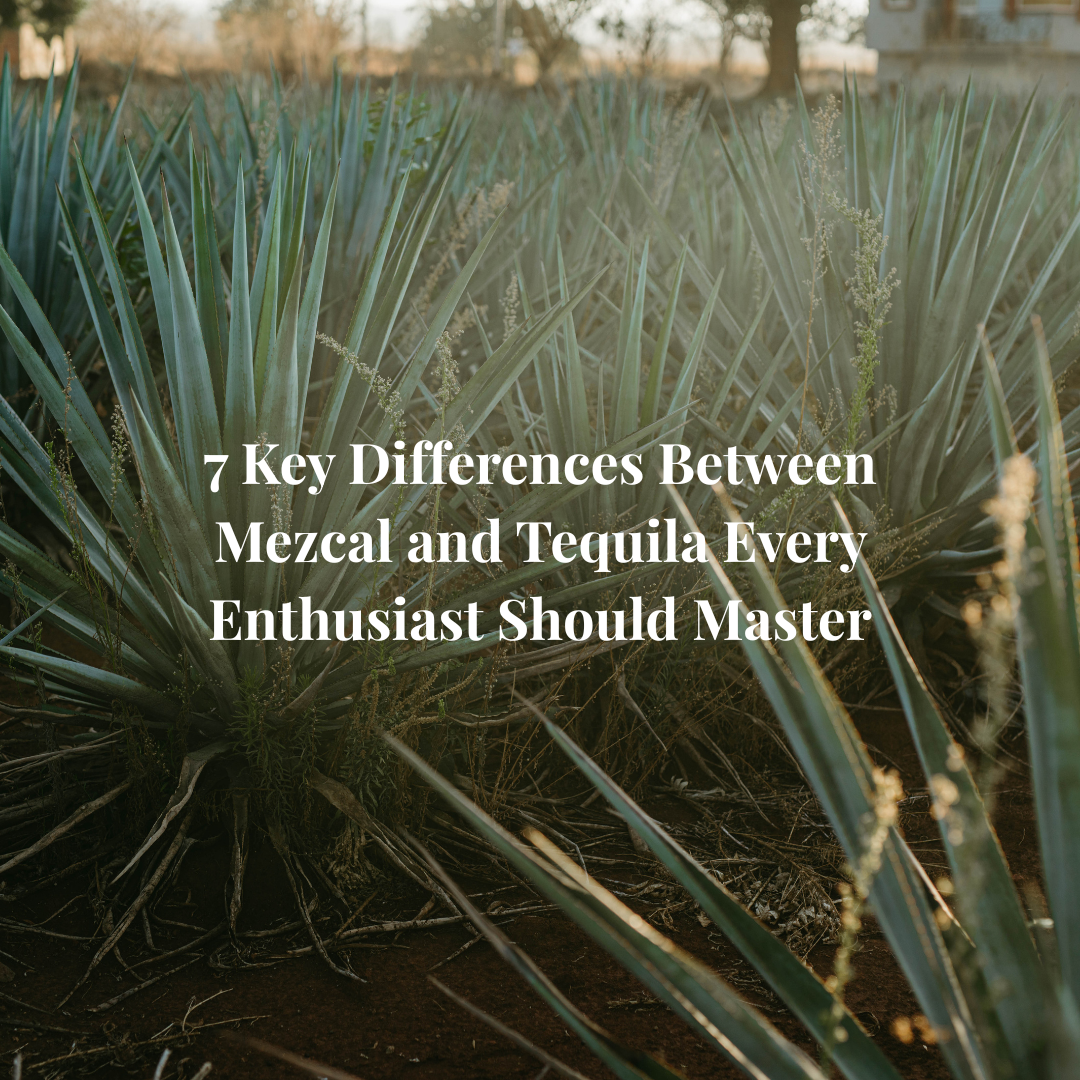
Tequila is a single-origin spirit in the most literal botanical sense: it must be produced exclusively from Agave tequilana Weber, Blue variety. That is the only agave on the approved list, full stop. The blue agave dominates the Jalisco highlands and lowlands, and its consistency is a feature, not a limitation. Tequila producers have spent decades learning exactly what that plant does and how to coax the best out of it.
Mezcal operates in an entirely different universe. The Consejo Mexicano Regulador de la Calidad del Mezcal (CRM) maintains a list of approved agave species that currently includes more than 40 varieties, spanning wild plants and cultivated ones, fast-maturing and multi-decade specimens. Espadin (Agave angustifolia) accounts for the vast majority of production, but producers also work with tobala, tepextate, mexicano, arroqueno, cuishe, madrecuixe, sierra negra, and many others. Each species brings a distinct aromatic and flavor profile to the still. Some of these plants grow wild, some are semi-cultivated, and some are beginning to face genuine conservation pressure because demand now outpaces natural regeneration.
This difference alone explains why mezcal is harder to characterize as a single flavor profile. You are not always comparing like with like when you line up mezcals from different producers.
2. Where the Spirits Are Made
Both tequila and mezcal carry Denominaciones de Origen (DO), the Mexican equivalent of a European controlled designation of origin, which means the spirits can only be produced in specific geographic zones.
Tequila’s DO covers the entire state of Jalisco plus designated municipalities in four other states: Guanajuato, Michoacan, Nayarit, and Tamaulipas. Jalisco is the core. Almost all tequila you will ever encounter comes from somewhere in that state, with the highland town of Arandas and the lowland city of Tequila functioning as the two informal capitals of the industry.
Mezcal’s DO is both broader and more complex. It covers eight states in full or in part: Oaxaca, Durango, Guerrero, San Luis Potosi, Zacatecas, Tamaulipas, Michoacan, Puebla, and Guanajuato. Oaxaca dominates production and is home to the greatest concentration of distilleries, but producers in Durango working with cenizo agave or in Guerrero working with papalome are making mezcal under the same DO. Geography, agave species, and local tradition interact to produce regional styles that are as different from one another as Oaxacan espadin is from Durango cenizo.
3. How the Agave is Cooked
Both tequila and mezcal production require cooking the agave pinas to convert their complex fructans into fermentable sugars. How that cooking happens is where the two categories diverge most sharply.
Tequila producers primarily use one of two methods. The traditional approach uses above-ground hornos, which are masonry or clay ovens where pinas are steam-cooked over 24 to 72 hours. The industrial approach uses autoclaves, which are pressurized stainless-steel vessels that accomplish the same conversion in a fraction of the time, sometimes as few as eight hours. Autoclaves are efficient, consistent, and widely used by larger producers. They are not inherently inferior, but they produce a different character in the final spirit than a slow horno cook does.
Traditional mezcal production uses an underground pit oven, called a palenque or horno de tierra, which is a conical pit lined with volcanic rocks that are heated by burning wood. The pinas are loaded in, covered with fiber, earth, and sometimes agave leaves, and slow-cooked for three to five days. It is this process that produces the smoky, earthy character mezcal is known for. The wood species used, the stone type, the size of the pit, and the duration of the cook all influence the final flavor. Some producers in the Artesanal and Mezcal (industrial) categories use above-ground ovens, autoclaves, or diffusers, so cooking method is not uniform across all mezcal.
4. Smoke: The Most Misunderstood Difference
Here is where many enthusiasts get tripped up. Smoke is not a defining legal characteristic of mezcal. It is a frequent byproduct of traditional pit-cooking, and many mezcals are notably smoky. But smoke intensity varies enormously depending on the producer, the agave, the wood used, and the cooking duration. Some mezcals from producers who use above-ground ovens or who manage their pits carefully are barely smoky at all.
Conversely, if you encounter a tequila with a smoky character, something unusual has happened at the production level. That is not a tequila trait. The smoke in mezcal is a consequence of process, not a flavor additive, which is why producers who care about quality treat it as one variable among many rather than the point of the spirit.
The practical takeaway: do not write off mezcal because you tried one that tasted like a campfire, and do not assume a lightly smoked mezcal is somehow less authentic than an aggressively smoky one.
5. What Can Go Into the Fermentation
This is one of the least discussed differences outside of serious enthusiast circles, and it matters a great deal for the quality of what ends up in your glass.
Tequila regulations allow for what is called a mixto: a tequila produced from a minimum of 51 percent blue agave sugars with the remaining fermentable sugars coming from other sources, typically cane or corn sugar. Mixto tequilas are required to be labeled as “tequila” but are not required to say “mixto” prominently. If a bottle does not say “100% agave” or “100% de agave” somewhere on the label, there is a good chance it is a mixto. The cheap tequilas responsible for a lot of bad mornings are almost exclusively mixtos.
Mezcal regulations require that all fermentable sugars come from agave, period. There is no mezcal equivalent of the mixto. This 100 percent agave requirement is built into the base standard. It is one reason why mezcal at comparable price points often delivers more complexity than its tequila counterpart.
6. How Each Category Classifies Its Spirits
Tequila uses an age-based classification system. Blanco (also called silver or plata) is unaged or rested for fewer than 60 days in oak. Reposado is aged between two months and one year in oak barrels. Anejo is aged between one and three years. Extra Anejo is aged more than three years. There is also Joven (young gold), which is typically a blanco with added colorings or flavorings, though some are genuine blends of blanco and aged tequila.
Mezcal uses a system that classifies spirits by production method rather than primarily by age, which reflects the category’s traditional roots. The three production tiers are Mezcal (the base category, which permits industrial production methods including autoclaves and diffusers), Artesanal (which requires the use of traditional tools and prohibits autoclaves and column stills, though modern mills are permitted), and Ancestral (the most restrictive tier, which requires clay pot distillation, stone tahona or hand-crushing mashing, and open-air or underground fermentation). Within each tier, age statements (Joven, Reposado, Anejo) can also be applied.
Understanding this tiered production system is essential for mezcal literacy. A bottle labeled Ancestral is making a claim about how it was made, not just how old it is. A bottle labeled Artesanal tells you something about the tools and methods the producer used. Neither label is a guarantee of quality on its own, but both carry meaningful information.
7. Regulatory Oversight and the Scale of Each Industry
Tequila is one of the largest spirits categories in the world by volume, and it has a regulatory structure that matches its scale. The Consejo Regulador del Tequila (CRT), founded in 1994, oversees every aspect of tequila production, from agave sourcing through bottling and export. Its inspectors are present at certified distilleries, and its certification process is exhaustive. The CRT issues NOM (Norma Oficial Mexicana) numbers to each certified producer, and those numbers appear on every legitimate bottle of tequila. If there is no NOM number, it is not tequila.
Mezcal’s regulatory body, the CRM (Consejo Mexicano Regulador de la Calidad del Mezcal), also issues certification numbers that appear on bottles as CRM numbers. The mezcal industry is considerably smaller than tequila’s by volume, but it has grown rapidly over the past decade and the CRM has faced persistent criticism about enforcement capacity, transparency, and the cost of certification for small producers. Some traditional producers in states like Guerrero and Puebla operate outside the DO entirely, not because they are doing anything wrong, but because the certification process is expensive and logistically difficult for remote palenques.
Scale also matters in practical terms. Tequila is a multi-billion dollar global industry dominated by large brands, many of them owned by multinational spirits companies. Mezcal, while growing, remains mostly a craft-scale industry where individual palenqueros and small family operations account for a significant share of production. This is beginning to change as investment flows in, but the average mezcal bottle still traces back to a smaller operation than the average tequila bottle.
None of this is meant to position one spirit above the other. Tequila and mezcal are separate traditions that happen to share a raw material, and both repay serious attention. What this framework gives you is a way to read a label, ask smarter questions, and notice what you are tasting. The category designation tells you something about the agave used, the geography, the production method, and the regulatory environment behind what is in the bottle. The rest is up to the distiller, the plant, and you.