
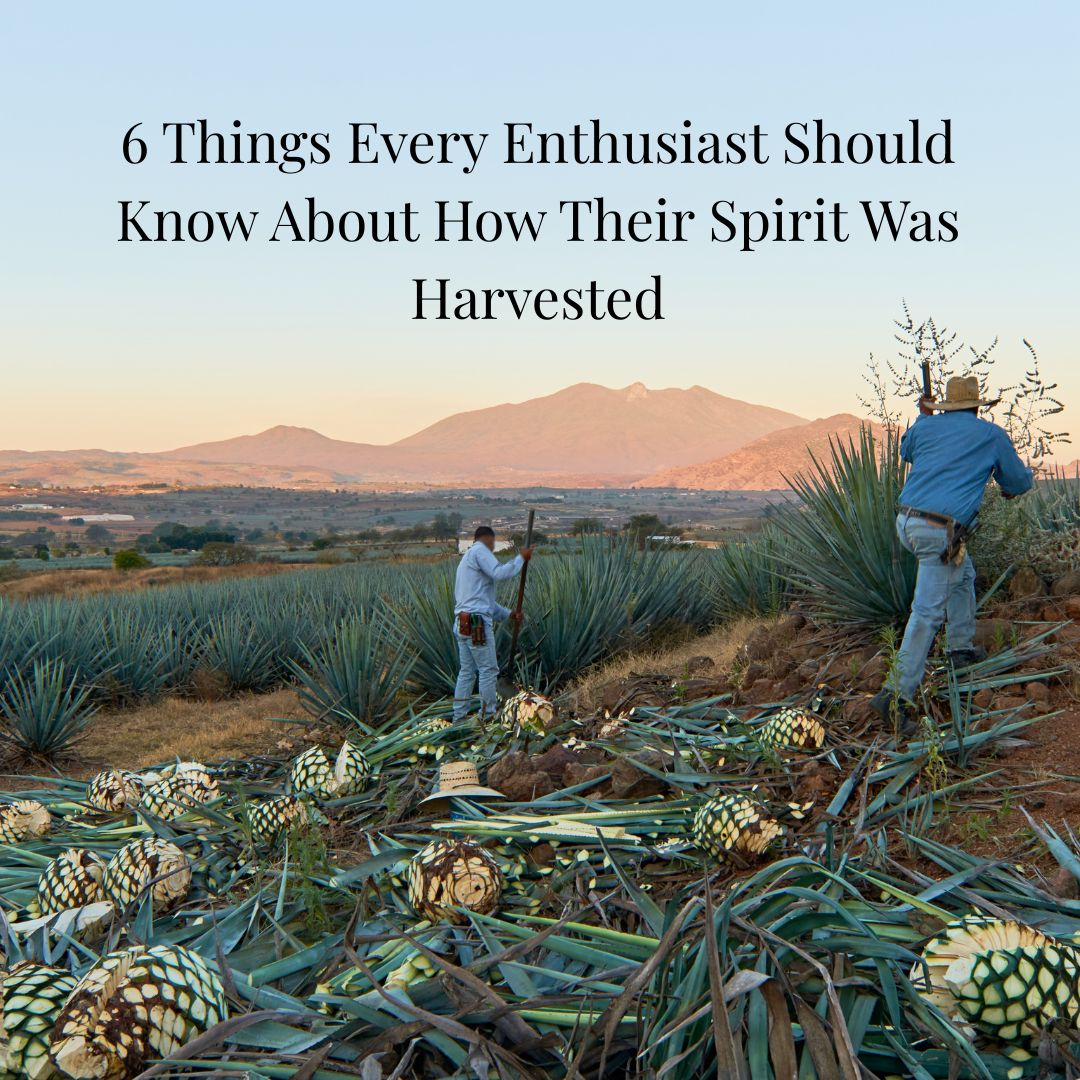
The bottle on your shelf holds years of patience. Maybe a decade. Maybe two. The liquid inside was shaped by rainfall, altitude, soil chemistry, the genes of a specific plant population, and the hands of the person who cut it from the earth. Most drinkers know vaguely that agave takes a long time to grow. Far fewer understand what actually happens at harvest, or why it matters for what ends up in the glass. Here is what you should know.
1. The Plant Sets the Timeline, Not the Calendar
Agave is not harvested on a schedule. There is no fixed season, no universally agreed-upon month, no harvest moon to watch for. A blue agave (Agave tequilana) planted in the red clay soils of the Los Altos highlands in Jalisco might take seven to ten years to reach maturity. A wild maguey espadin growing in the mountains of Oaxaca could take ten to fifteen. A wild tobala (Agave potatorum) or tepeztate (Agave marmorata) might take twenty-five years or more before it is ready. What signals readiness is not a calendar date but the plant itself.
The primary signal is the quiote. When an agave approaches the end of its life cycle, it sends up a massive flowering stalk that can climb several meters in a matter of weeks. This is the plant’s final act: it redirects everything it has stored in its heart outward to feed the stalk, the flowers, and eventually the seeds. For a producer who wants to make spirit, this is also the moment to act. If the quiote is allowed to fully develop, the sugars that would otherwise ferment into alcohol are consumed by the flowering process. Most jimadores cut the quiote at the base when it first appears, a practice called capado, to keep those sugars locked in the heart. The plant is, in essence, prevented from completing its life cycle so that its energy can be redirected into the bottle.
This is why you will sometimes see the phrase ‘plants harvested at peak maturity’ on a label or in a producer’s notes. It is not marketing language. Harvest timing is a genuine craft decision with real consequences for flavor and fermentable sugar content.
2. The Jimador Is Reading the Plant, Not Just Cutting It
The jimador, the skilled harvester of agave, is among the most underappreciated craftspeople in spirits production. Their work requires years of training, physical endurance, and a kind of botanical literacy that takes a lifetime to develop.
A jimador works with a specialized tool called the coa de jima: a long wooden handle fitted with a wide, flat, sharpened blade. With it, they strip the long, spiny leaves, called pencas, from the agave one by one, working around the plant’s core until only the heart, the pina, remains. The word pina is apt. Once stripped, the agave’s heart looks like a massive pineapple, pale and dense, sometimes weighing 40 kilograms, sometimes over 100. The work is precise. Cut too aggressively into the pina and you lose fermentable material. Leave too many pencas attached and you introduce bitter chlorophyll compounds into the cook.
Experienced jimadores can assess the maturity and sugar content of a plant by sight and touch before a single cut is made. They are looking at the color and texture of the leaves near the base, the firmness of the core, the way the pencas have dried and pulled back. Some producers now use brix meters to measure sugar concentration. But in traditional communities, the jimador’s eye is still the primary instrument, and it is rarely wrong.
3. Wild and Cultivated Harvests Are Entirely Different Operations
The harvest of cultivated agave on a tequila estate, with plants in orderly rows across manicured fields and tractors moving between them, looks nothing like the harvest of wild maguey in the mountains of Guerrero or the canyons of San Luis Potosi. Both produce agave spirit. The similarities largely end there.
Wild harvest, and the semi-wild harvest of plants that are managed but not formally cultivated in rows, involves locating individual plants across rugged terrain, often at altitude. A jimador working wild agave may hike for hours before reaching a productive stand. The pinas are cut and carried out by hand or on the back of a burro, sometimes in pieces if the terrain or the size of the plant demands it. A single day’s work might yield a handful of plants.
The trade-off is real on both sides. Wild and semi-wild agave tend to contribute greater complexity to the finished spirit. This reflects genetic diversity within wild populations, the terroir of varied micro-climates across steep mountain terrain, and the extended maturation times that come with growing conditions that are never optimized for fast production. A wild espadin left to mature for fifteen years in rocky, nutrient-poor soil will have a different chemical profile than a cultivated espadin harvested at eight. Neither is inherently better, but they are different, and that difference is detectable in the glass.
4. How the Pina Is Handled After Harvest Affects the Spirit
Once stripped, the pina has to get to the distillery. In the highlands of Jalisco, with good road access and organized logistics, this is straightforward. In the mountains of southern Mexico, it is not. Traditional mezcal producers in remote communities often quarter or halve large pinas in the field to make them portable. Some still use pack animals. Others have cut in roads over the years, or use ATVs. A handful of producers have reportedly used helicopters for the most inaccessible harvests.
The time between harvest and cook matters. Agave pinas that are bruised, split, or left sitting in the field in warm weather will begin to undergo microbial activity on their cut surfaces. Some producers view a brief period of resting as beneficial, allowing surface yeasts to develop that will later contribute to fermentation. Others move the pinas to the roasting pit or autoclave as quickly as possible to maintain sugar content and minimize uncontrolled microbial development. There is no universal right answer. Both philosophies produce excellent spirits. But the choice is intentional, and producers who are thinking carefully about it will tell you why they do what they do.
Industrial tequila production handles this differently. Large mechanical shredders and high-pressure autoclaves can process enormous volumes of agave efficiently and quickly, minimizing the variables introduced by time and handling. This is not inherently inferior, but it is a different approach, with different flavor outcomes, and enthusiasts are well served by understanding the distinction.
5. Harvest Timing Within the Maturity Window Has Flavor Consequences
Agave does not reach maturity on a single day and hold there indefinitely. There is a window, and where in that window a producer chooses to harvest carries flavor implications.
At peak maturity, just as the quiote is emerging but before it has drawn down the plant’s reserves significantly, sugar concentration is at its highest. Pinas harvested here ferment efficiently and tend to produce spirits with good body and clear agave character. Pinas harvested earlier, before the plant has fully converted its starches to fermentable sugars, may produce spirits that taste thin, green, or vegetal. Pinas harvested after a quiote has been growing for weeks or months, or worse, after the plant has flowered, are sugar-depleted and will ferment poorly.
Season adds another layer. Agave harvested during the dry season often shows higher brix readings than agave cut during or just after the rainy season, when the plant has been taking on water. Temperature variation in the months before harvest affects how the plant stores and distributes carbohydrates. This is one reason why small-batch, single-harvest mezcals can vary significantly from one bottling to the next, even when the producer, the species, and the land are identical. The variation is not a flaw. It is evidence that the product is connected to something real.
6. The Sustainability Question Is Real and It Requires Your Attention
Here is something worth sitting with: the agave in your glass took years, possibly decades, to grow. And demand for agave spirits has never been higher in the history of the category.
The tequila industry has been through agave shortage cycles before. The most severe in recent memory hit in the late 1990s, when a combination of disease pressure from the agave weevil (known as picudo), damaging frosts, and rapidly accelerating demand pushed the industry to the edge of a supply collapse. The industry responded by planting aggressively, but the monoculture that resulted created its own set of vulnerabilities: a landscape of genetically identical plants, almost all propagated vegetatively, with limited resistance to disease or climate stress.
For mezcal and other traditional agave spirits, the situation is more varied and in some ways more urgent. Dozens of species are used across producing regions, and many of them are slow to mature, difficult or impossible to cultivate at scale, and increasingly harvested from shrinking wild populations. Agave cupreata, used in much of Guerrero’s mezcal production, is under significant pressure. So are various wild tobala populations in Oaxaca and Puebla. The Mexican government has established regulations around harvest of some species through its environmental agency, but enforcement is inconsistent and the regulatory framework has not always kept pace with the growth of the industry.
What can an enthusiast actually do? Support producers who replant. Hijuelos, the vegetative offshoots that mature agave produce at their base, are the most common propagation method in traditional communities and can replace harvested plants over time if managed responsibly. Some producers also cultivate from seed, which introduces genetic diversity and is considered by many to be a more ecologically sound practice for wild species. Transparency about sourcing and replanting practices is increasingly available from producers who take this seriously. It is worth asking. It is worth reading labels and producer notes carefully. The bottle you buy is, in small but cumulative ways, a vote for the kind of industry you want to exist in twenty years.
The category rewards patience from the plants and from the people who drink them. The more you understand about how agave gets from the hillside to the distillery, the more the spirit in your glass will have to tell you.