From maguey field to finished bottle, here is what separates artisanal mezcal from everything else in your glass.
Not all mezcal is made the same way, and if you have spent any time in the category, you already know that. But knowing it and understanding it are two different things. The word “artisanal” gets thrown around constantly, in tasting rooms, on back labels, in marketing copy, sometimes accurately and sometimes not. So let us go step by step through the actual production process that defines artisanal mezcal under Mexico’s official regulatory framework, and more importantly, what each step means for what ends up in your glass.
Mexico’s Consejo Regulador del Mezcal (CRM) establishes three production categories: industrial, artisanal, and ancestral. This guide focuses on artisanal, the middle tier, which accounts for the vast majority of mezcal exported to the United States and Europe. Understanding what goes into a bottle at this level will make you a sharper buyer, a better host, and frankly, a more interesting person to drink with.
Step 1: Selecting and Harvesting the Agave
Everything begins with the plant. Agave, known in Mexico by its indigenous name maguey, is not a cactus, not an aloe, and not something you harvest annually. Depending on the species and growing conditions, a maguey plant takes anywhere from 6 to 35 years to reach maturity. Some wild varieties take even longer. This is not a crop you rush.
Artisanal mezcal can be made from a range of agave species. Espadin (Agave angustifolia) is by far the most common because it is cultivable and matures in 7 to 10 years. But many producers work with wild or semi-wild agaves: tobala, tepextate, cuishe, madrecuixe, arroqueno, and others, each with distinct flavor profiles shaped by genetics, soil, altitude, and rainfall.
When a maguey reaches maturity, it sends up a towering flower stalk called a quiote. Left alone, the plant would use all its stored sugars to produce seeds and then die. A skilled jimador removes the quiote before this happens, redirecting those sugars back into the central core of the plant, which is called the pina because it resembles a large pineapple. The jimador then harvests the pina using a traditional tool called a coa de jima, a broad, flat blade on a long wooden handle. The leaves, called pencas, are stripped away, leaving only the dense, sugar-rich heart.
In artisanal production, this work is done by hand. Wild agaves are often harvested in remote terrain, requiring mules or hand-carrying to get the pinas to the palenque (production site). The size of a pina varies considerably by species. An espadin pina might weigh 40 to 80 kilograms. A tepextate pina, which can take 25 years to mature, might weigh 120 kilograms or more.
Step 2: Roasting the Pinas
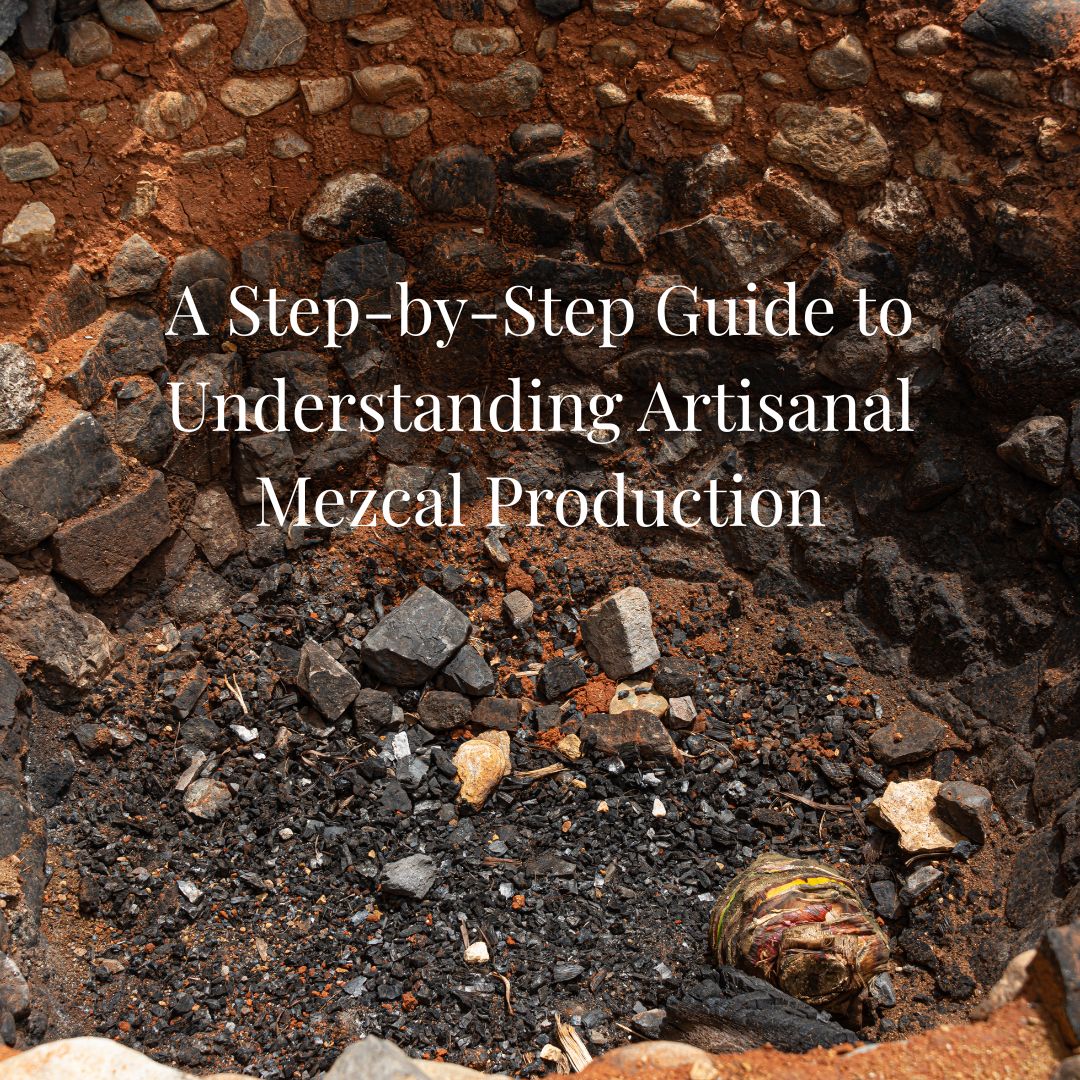
This is where mezcal begins to diverge fundamentally from tequila, which uses steam-cooking. Artisanal mezcal is roasted in an underground pit oven called a palenque pit or horno. The process is straightforward in concept and demanding in execution.
The producer digs a conical or cylindrical pit in the earth, typically lined with volcanic rocks. A fire is built at the bottom, heating the rocks to extremely high temperatures. Once the rocks are ready, layers of pinas are loaded in, often separated by mats of agave fiber, burlap, or other natural materials. The whole pile is then covered with more agave fiber, dirt, and sometimes canvas or tarps to trap the heat. The pinas roast in this underground oven for anywhere from three to seven days.
The roasting step is what gives mezcal its signature smokiness. The pinas do not actually touch open flame during most of the roast, but the heated rocks, the trapped steam, and the slow cooking process create a combination of caramelization and Maillard reactions that transform the agave’s starches into fermentable sugars while developing complex, layered flavors. The degree of smokiness in the finished mezcal is influenced by many variables: wood species used for the fire, rock temperature, roasting duration, and the specific agave variety.
Some consumers assume all mezcal is extremely smoky. That is not accurate. Mezcals made with certain agave varieties or with careful pit management can be lightly smoky, even elegant and floral. Others are intensely campfire-forward. The roast is one dial among many.
Step 3: Milling and Extraction
Once the pinas have been roasted and cooled, they need to be broken down so the fermentable sugars can be released. In artisanal production, this is done primarily by mechanical stone mill, though some producers still use a combination of stone milling with wooden mallets or other hand tools.
The most iconic milling method is the tahona, a large stone wheel, typically carved from volcanic rock, that is rolled in a circular stone basin. The tahona is usually pulled by a horse, mule, or ox. As the wheel rolls, it crushes the roasted pinas into a pulpy mass of fiber and juice. The process is slow and labor-intensive, which is part of why it is still considered a mark of quality by many in the industry, though the direct link between tahona use and flavor is debated among producers and researchers.
Some artisanal producers use a mechanical shredder, which is permitted under the artisanal category regulations. This distinction matters to some consumers and not at all to others. If it matters to you, it will be noted on the label or available via the CRM’s database.
A key feature of artisanal production: the fiber itself, called bagaso, is often included in fermentation rather than being discarded. This is significant. Including the bagaso adds texture, tannin-like qualities, and additional flavor compounds to the final spirit that would not be present if only the juice were fermented.
Step 4: Fermentation
Fermentation is where the crushed, roasted agave is transformed by yeast into alcohol. In artisanal mezcal production, fermentation happens in open-air wooden vats, animal hides, clay pots, or hollowed-out tree trunks, depending on the region and tradition of the producer. The CRM permits all of these for the artisanal category.
Crucially, artisanal mezcal production relies on natural, ambient yeast, not commercial yeast cultures. This is one of the most important distinctions in the category. Wild yeasts, drawn from the environment, the producer’s hands, the wooden fermentation vessels, and the agave plant itself, drive fermentation. Because wild yeast populations vary by location, season, and batch, no two fermentations are exactly alike. This is a feature, not a bug. It is one of the primary reasons that mezcal from the same producer can vary batch to batch in meaningful ways.
Fermentation can take anywhere from several days to a couple of weeks, depending on temperature, yeast activity, and the sugar content of the agave. Cooler conditions slow fermentation down. Warmer conditions speed it up, though overly rapid fermentation can produce off-flavors. Experienced producers read their fermentations visually, by sound, and by smell, adjusting conditions as needed without digital sensors or lab equipment.
Water is added to dilute the mash to workable consistency. In some regions, producers use only rainwater or water sourced from the same land where the agave grew. This is not required, but it reflects the broader philosophy of many artisanal producers: keep everything local, keep everything connected to place.
Step 5: Distillation
After fermentation, the liquid and remaining fiber are transferred to a still for distillation. Artisanal mezcal must be distilled in either copper pot stills or clay pot stills. Both are permitted. Industrial mezcal may use column stills or other continuous distillation equipment. Ancestral mezcal must use clay pots exclusively. This equipment distinction is one of the defining differences between categories.
Most artisanal mezcal is distilled twice. The first distillation, called the ordinario or primer destilado, produces a low-strength distillate. The second distillation refines and concentrates it. Some producers distill a third time, though this is more common in certain regions or with specific agave varieties where the distiller is chasing a particular texture or clarity.
Clay pot stills deserve special mention because they are relatively uncommon in global spirits production and produce a noticeably different result than copper. Clay is porous and does not conduct heat as efficiently as copper, which changes how vapors rise and condense. Many producers and drinkers describe clay-distilled mezcal as earthier, richer, and more mineral-driven.
During distillation, the maestro mezcalero makes cuts. The heads, the first portion to come off the still, contain undesirable compounds like methanol and aldehydes. The tails, the last portion, contain heavier, fatty alcohols. The heart, or cuerpo, is what gets kept. Experienced maestros make these cuts by taste, touch, and by observing the behavior of the spirit as it runs. Traditional distillers in some regions blow bubbles in the liquid to assess alcohol content and bead pattern. This method, called la perla, is an ancient technique still practiced by skilled producers.
Step 6: Blending, Resting, and Proofing
Once distillation is complete, the maestro mezcalero blends fractions from different distillation runs to achieve consistency. Because every batch varies slightly, this blending step is where the producer’s hand becomes most visible, knitting together different batches to hit a target profile.
Most artisanal mezcal is released as joven (young and unaged), because the goal is to express the agave and the terroir, not wood character. Aging in wood is permitted in the artisanal category and results in reposado (rested 2 to 12 months) or anejo (aged more than 12 months) expressions, though wood-aged mezcal represents a smaller share of the overall market.
Proofing, the step of diluting the spirit to its target alcohol level, is done with water. Artisanal mezcal typically lands between 40 and 55 percent ABV, though some producers bottle cask strength or at very high proofs. Higher-proof expressions often carry more intense aromatics and a different mouthfeel, which some drinkers strongly prefer.
Step 7: Certification and Bottling
Before a mezcal can be sold under that name, it must be certified by the CRM. The producer submits samples for chemical analysis and documentation proving the agave species, production location, and production method. If approved, the batch receives a hologram and a unique lot number that gets printed on the label. Consumers can look up any certified mezcal using the CRM’s public database, which is a genuinely useful resource for doing your homework before buying.
Bottling is typically done locally, though some brands bottle in Mexico City or at centralized facilities. The label on a certified mezcal is required to list the agave species, the state of production, the production category (artisanal, in this case), and the name of the maestro mezcalero. Reading a mezcal label carefully will tell you a great deal about what is in the bottle, which is one of the things that makes this category genuinely exciting for engaged consumers.
Why Any of This Matters
You might be wondering whether any of this production detail actually affects your experience. The honest answer is: yes, significantly.
Each step in artisanal mezcal production is a variable. The species and age of the agave, where it grew, how the pit was fired, what wood was used, how long the pinas roasted, how fermentation was managed, what the local yeast population looks like, whether clay or copper was used for distillation. All of these interact. The mezcal you pour from a single-batch bottle is a direct record of decisions made by a person in a specific place, often using techniques handed down through generations.
This is not romanticization. It is chemistry and tradition intersecting. Industrial mezcal uses standardized inputs and equipment designed to eliminate variation. Artisanal mezcal, by definition and by practice, does not. What you get in exchange for that variability is specificity, character, and a genuine connection to place that most spirits categories simply cannot offer.
The next time someone hands you a mezcal and mentions it is artisanal, you now have a framework for what that actually means, not as marketing language, but as a real description of process. Ask about the agave variety. Ask where it was grown. Ask how long the fermentation ran and what the still was made of. You might find that the producer, or the importer, cannot answer those questions. That, too, is useful information.