
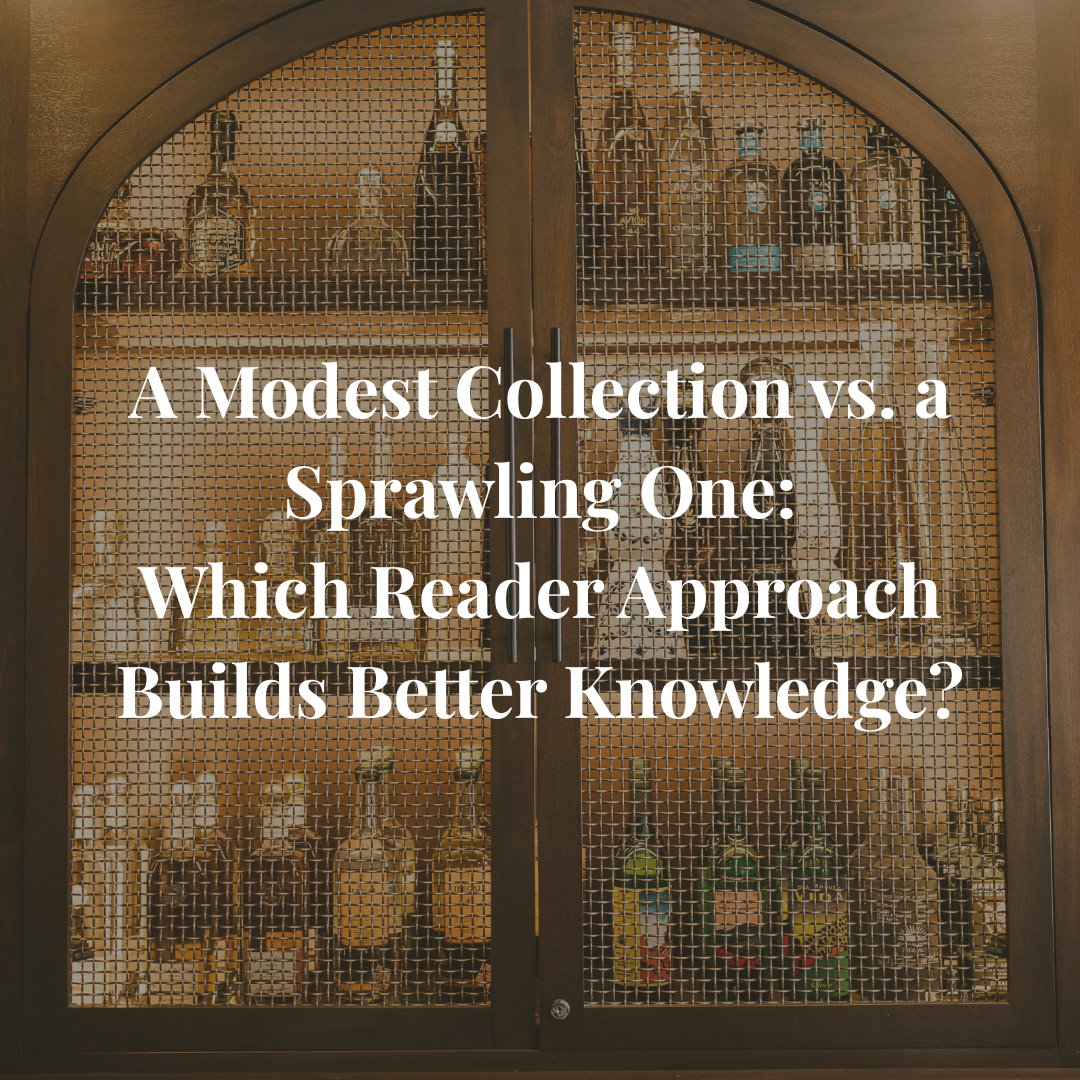
Ask a hundred serious agave spirits enthusiasts how they built their palates and you will get a hundred different answers. But beneath the specifics, the strategies tend to cluster around two poles: the focused collector who works systematically through a single category, producer, or agave variety until they know it cold; and the wide-net drinker who grabs whatever is new or unfamiliar and trusts that sheer volume of exposure will do the teaching.
What a Modest Collection Actually Teaches You
Focused repetition within a defined category trains the brain to recognize small differences rather than large ones. If you spend six months working through a handful of Oaxacan producers who all make espadin mezcal in roughly similar ways, the differences you start to notice are telling: a slightly longer roast here, a different water source there, a master distiller who runs his stills slower and produces a heavier distillate. You start to understand what variation looks like within a controlled framework.
A modest collection also forces patience. The collector who revisits the same four or five bottles across a season and takes notes at different times of day, with different foods, in different moods, is gathering data that the horizontal taster never will.
What a Sprawling Collection Actually Teaches You
A wide collection gives you context at scale. Agave spirits are not a single tradition. A collector who has worked through espadin from multiple states, tasted a proper Jalisco raicilla, worked through some lowland and highland tequilas side by side, and opened a bottle or two of Durango-made cenizo mezcal has a sense of the full terrain that the narrow collector lacks.
Wide exposure also accelerates your ability to identify what is unusual. A collector who has tried thirty different mezcals will notice immediately when something is off, or exceptional, in a way that a collector working within a single narrow band might not. Breadth builds a kind of broad-spectrum recognition that depth alone cannot provide.
The Trap on Each Side
The modest collector risks insularity — developing real depth in one corner while remaining blind to everything outside it, and potentially mistaking that corner for the whole category. The sprawling collector risks accumulating impressions without the framework to interpret them. If you have tasted a hundred different bottles but never sat with any of them long enough to understand what you are actually tasting, the hundred bottles add up to a list, not knowledge.
The Case for Sequencing
What most experienced collectors eventually discover is that the modest and sprawling approaches are not competitors. They are phases. The collector who starts narrow, builds a genuine reference framework, and then expands outward is doing something systematically intelligent. The sequence matters more than the starting point. The question to ask yourself is not whether your collection is modest or sprawling. It is whether you are learning from it.
One practical framework: anchor bottles and exploratory bottles. Anchor bottles are familiar expressions you return to regularly, calibrating your palate before and after you try something new. Exploratory bottles are new territory, bought to be studied in relation to the anchors. Most collectors who have thought about it deliberately tend toward something like one anchor for every three or four exploratory bottles.
What the Category Demands
The reader who builds better knowledge is not necessarily the one with the biggest collection or the smallest one. It is the one who collects with intention, who can articulate what a given bottle is teaching them, and who is honest enough to admit when they do not know something well enough to have an opinion about it yet. In agave spirits, that quality is more valuable than the size of anyone’s shelf.