
A colonial-era plant, a pandemic-born brand, and a new category that is asking the global spirits world to reconsider what agave can be.
For more than half a century, the global agave spirits conversation has been conducted in Spanish. Jalisco and Oaxaca have set the terms, defined the categories, and built the regulatory frameworks that govern how the world understands tequila and mezcal. That dominance is well earned. But it has also created a blind spot: the assumption that serious agave spirits can only come from Mexico.
Maya Pistola Agavepura, launched in 2022 by sibling entrepreneurs Rakshay and Radhika Dhariwal, is making a compelling case that the assumption is wrong. Based in India, sourcing wild Agave Americana from the Deccan Plateau and aging in Goa, Pistola is not trying to imitate tequila. It is building something new. The brand coined the term agavepura to describe its approach: 100 percent agave, completely additive-free, and rooted in a terroir that has nothing to do with Jalisco.
Whether you find that exciting or heretical probably depends on how narrowly you define the agave spirits category. But with over 50 international awards, a strategic investment from Diageo, and a recent UK launch through The Whisky Exchange, Pistola has moved well past the novelty phase. It is time to take it seriously.
How Agave Got to India
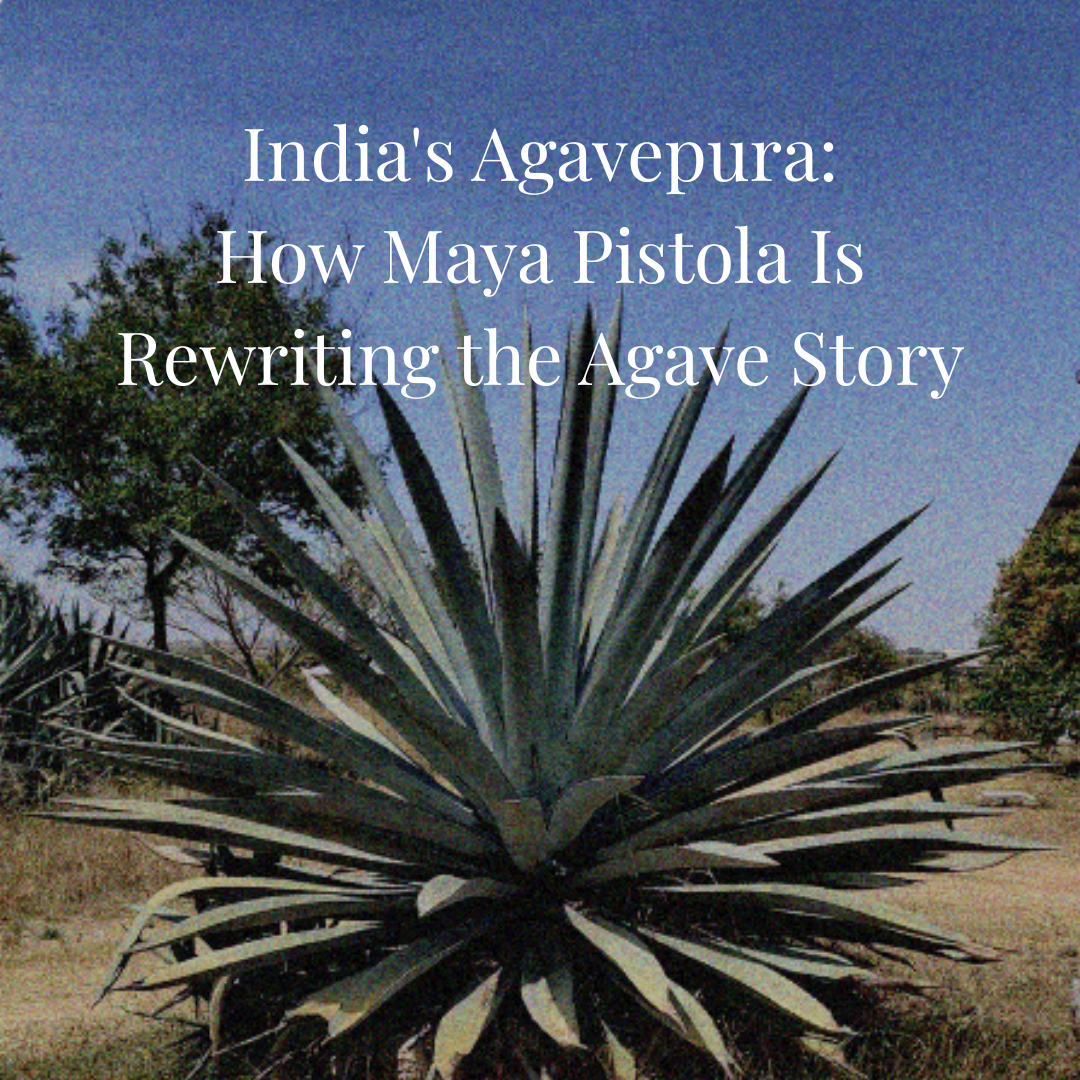
The story of agave in India is older than most people expect. During the colonial era, the British introduced Agave Americana to the subcontinent, primarily as a practical measure. The plants were used to fence off railway lines across southern India, keeping cattle from wandering onto the tracks. The agave adapted remarkably well to the arid, volcanic soils of the Deccan Plateau, the same kind of sun-baked highland terrain where agave thrives in Mexico. Over the following two centuries, the plants naturalized and spread across the region, growing wild with no commercial harvesting to speak of.
That changed in 2011, when Desmond Nazareth launched DesmondJi from a micro-distillery in Chittoor, Andhra Pradesh, creating India’s first official agave spirit. Pistola is the second brand to enter this space, but it has moved fast and aimed high. The Dhariwals source their agave from the Chittoor district in Andhra Pradesh, selecting mature plants that have reached eight to ten years of age. The plants are wild, not cultivated on plantations, and they produce hefty piñas weighing between 100 and 200 kilograms, roughly double what a typical Blue Weber yields in Jalisco.
From Fire to Phoenix
The origin story of Pistola includes a chapter that would sound contrived if it were not documented. Rakshay Dhariwal began developing the brand in March 2020, after the pandemic shuttered his 18 bars and restaurants across India. By late 2021, Pistola was ready to launch. Then, on Christmas Eve, the distillery in Goa caught fire. The entire facility and roughly 6,000 liters of maturing spirit were destroyed. Dhariwal rebuilt, constructing a new facility five times larger than the original and adding a second maturation site in Goa. The brand finally launched in 2022, and one of its limited-edition releases, the Phoenix Anejo, aged for 20 months in American White Oak, takes its name from that fire.
What Is Agavepura, Exactly?
The term agavepura, pronounced pure-ah, is Pistola’s own coinage, and the brand is building it into something more than a marketing slogan. The idea is straightforward: 100 percent agave spirit, zero additives, no artificial coloring. The Dhariwals point out that under existing Mexican regulations, a spirit labeled 100 percent agave can still legally contain up to one percent additives by volume, enough to meaningfully alter the flavor profile of a finished product. Agavepura, as Pistola defines it, means none of that.
The Whisky Exchange, one of the most respected specialty retailers in the global spirits market, created a dedicated agavepura category when it brought Pistola on board for its UK launch in late 2025. That is not something a retailer does for a novelty product.
The Production Process
Pistola’s production follows a path that will feel familiar to anyone who has spent time in a traditional Mexican distillery, with a few key differences. The wild Agave Americana piñas are harvested from the Deccan highlands, then cooked using steam and high-pressure autoclaves to convert starches into fermentable sugars. After cooking, the piñas are milled and the juice is fermented in wooden vats with yeast. The resulting wash is double distilled in part-copper pot stills.
From there, the liquid is transported to Goa, where aging takes place in a combination of virgin American White Oak, ex-bourbon, and ex-red wine casks. The brand currently offers five core expressions: the Joven, Reposado, Rosa (aged in ex-Cabernet Sauvignon barrels), Anejo, and Extra Anejo. Two limited-edition bottlings round out the lineup. All expressions are non-chill filtered.
Awards and Validation
Pistola’s track record on the awards circuit has been strong enough to command attention. The brand has accumulated more than 50 international and domestic accolades since its 2022 launch, including a Master medal at The DB & SB Spring Blind Tasting 2023, Double Gold at the SIP Awards, and Gold medals at the Asian Spirits Masters 2024. In 2025, the Reposado was named Spirit of the Year for India at the USA Spirits Ratings, scoring 95 points.
The Diageo Investment
In April 2024, Diageo India’s subsidiary United Spirits acquired a 15 percent stake in Inspired Hospitality, Pistola’s parent company. Dhariwal has described the partnership as significant beyond its dollar value, noting that it represents the first time Diageo has invested in a non-tequila agave spirit anywhere in the world.
What This Means for the Agave World
Let’s be clear about what Pistola is and is not. It is not tequila, and it is not trying to be. It uses a different species of agave (Americana rather than Blue Weber), grown in different soil and climate conditions, and processed in a country with no regulatory framework comparable to Mexico’s CRT or Denomination of Origin. It has no centuries-old mezcalero tradition behind it.
But the agave conversation has always been bigger than Mexico, even if it has not always been treated that way. What makes Pistola notable is not the fact that someone is making agave spirit outside of Mexico. What makes it notable is that someone is doing it at a high level, winning major competitions, attracting institutional investment, and creating a new category with enough credibility that a flagship retailer is willing to build a shelf set around it.
Maya Pistola is not asking you to abandon your favorite bottle from Jalisco or Oaxaca. It is asking you to consider that the agave story has a new chapter, written in a language you might not have expected, from a terroir you probably have not tasted before. Whether that chapter becomes a footnote or a turning point depends on what happens next. But the early pages are hard to argue with.