
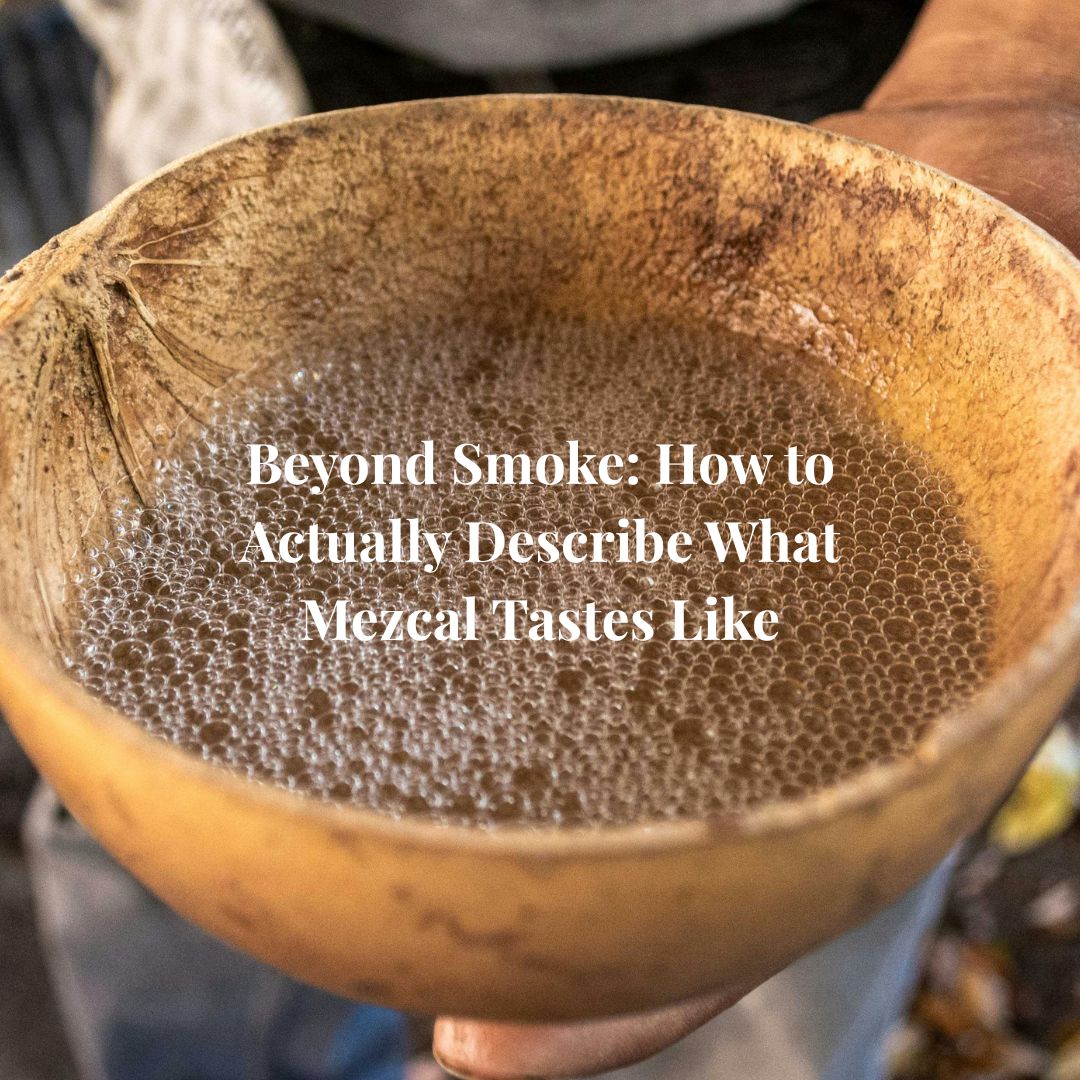
Ask someone who has never tried mezcal what it tastes like and they will almost certainly say “smoky.” Ask someone who drinks it regularly and you will get a longer answer, but it will probably still start with smoke. That word has become the default descriptor for an entire category of spirits, and while it is not wrong, it is so reductive that it borders on useless. Describing mezcal as smoky is like describing wine as grape-flavored. It tells you almost nothing about what is actually in the glass.
The truth is that mezcal is one of the most aromatically and texturally diverse spirits on Earth. A single category contains expressions that range from bright and herbaceous to deeply mineral, from floral and perfumed to savory and funky, from lean and dry to rich and almost oily on the palate. Describing what mezcal tastes like requires a vocabulary that goes well beyond a single word, and building that vocabulary is one of the most rewarding things a spirits enthusiast can do.
Start With What You Already Know
If you are new to tasting mezcal and struggling to put words to what you are experiencing, start with broad categories rather than trying to pinpoint specific flavors. Most mezcals will land somewhere on a few basic spectrums: fruity to savory, light to heavy, dry to sweet, bright to earthy. Just placing a mezcal on those axes gives you a framework that is far more useful than reaching for the word “smoky” and calling it a day.
From there, think in terms of flavor families. Citrus is a big one. Many mezcals, particularly those made from espadin agave, carry notes that fall somewhere in the citrus family: lemon peel, lime zest, grapefruit pith, dried orange. Green and herbaceous notes are equally common: fresh-cut grass, green bell pepper, cilantro, mint, basil. Earth tones show up across the category: wet clay, mineral-rich soil, slate, chalk, volcanic rock. And yes, smoke is a flavor family too, but within that family there is enormous range. The smoke in a mezcal can read as campfire, as roasted chili, as charred wood, as smoked leather, as incense. Saying a mezcal is smoky without specifying what kind of smoke is like saying a dish is spicy without saying whether it is a habanero or a black peppercorn.
The Agave Tells You Everything
The single biggest variable in mezcal flavor is the agave variety used to make it. There are more than 50 species and varieties of agave currently used in mezcal production across Mexico, and each one brings a fundamentally different aromatic and textural profile to the spirit. This is one of the things that makes mezcal so endlessly interesting and so difficult to summarize with a single descriptor.
Espadin, the most widely cultivated agave for mezcal, tends to produce spirits with a relatively approachable profile: medium body, moderate smoke, notes of roasted tropical fruit, citrus, and green herbs. It is the baseline, the reference point most tasters build from.
Tobala, a small wild agave that grows at higher elevations, typically delivers a more perfumed, floral spirit with notes of jasmine, stone fruit, and sometimes a waxy, honeyed quality. Tobala mezcals are often lighter in body and carry less overt smoke, which makes them particularly eye-opening for people who think all mezcal tastes the same.
Tepeztate, one of the longest-maturing agave varieties, often produces spirits with a pronounced savory streak: green olive, vegetal funk, damp earth, and sometimes a briny, almost maritime quality. Tepeztate mezcals can be polarizing, but they reward patient tasters who are willing to sit with the glass.
The karwinskii complex, which includes varieties known as madrecuixle, tobaziche, and barril, tends toward mineral-driven expressions. Chalk, limestone, graphite, and a distinctive leanness on the palate are common hallmarks. These are mezcals that often taste more like the land than like the plant itself.
Cuishe, another member of the karwinskii group, frequently shows a bright, almost electric acidity alongside green vegetal notes and a pronounced minerality. It is one of the most distinctive profiles in the category, immediately recognizable to experienced tasters.
And then there are the wild agaves that appear in limited quantities: arroqueno with its broad, chocolatey richness; mexicano with its peppery bite and citrus brightness; sierra negra with its dense sweetness and tropical fruit. Each variety is a different conversation.
Production Shapes the Story
The agave variety sets the foundation, but production decisions layer additional complexity on top of it. The way the agave is cooked determines how much and what kind of smoke enters the spirit. Earthen pit roasting, the most traditional method, generates the heaviest smoke influence. Above-ground stone or brick ovens produce a gentler roast with less smoke and more caramelized sweetness. Autoclave ovens, used primarily in larger-scale production, cook the agave with steam and introduce no smoke at all.
The type of still matters too. Copper pot stills tend to produce a cleaner, more polished distillate with brighter aromatics. Clay pot distillation, the ancestral method, yields a spirit with a rounder, earthier texture and often introduces additional mineral notes from the clay itself. Filipino-style stills, used in some regions, produce a distillate with a distinct character that is lighter and sometimes grassier.
Fermentation is another variable that shapes the flavor you taste in the glass. Open-air fermentation in wooden vats exposes the mash to ambient yeasts and bacteria, which can generate a wide range of secondary flavors: tropical fruit esters, yogurt-like tanginess, barnyard funk, and floral complexity. Controlled fermentation in stainless steel produces a cleaner, more predictable profile with fewer of those wild secondary notes.
Water source, altitude, ambient temperature during fermentation, even the type of wood used in the roasting pit: all of these contribute to what ends up in your glass. Mezcal is a spirit of accumulation. Every decision in the production chain leaves a fingerprint.
Building Your Tasting Vocabulary
The best way to develop a vocabulary for describing mezcal is to taste comparatively. Pour two or three expressions side by side. Different agave varieties from the same producer. Same agave variety from different regions. Espadin from Oaxaca next to espadin from Durango or Puebla. When you taste in comparison, the differences become obvious in a way they never do when you taste a single expression in isolation.
As you taste, pay attention to four dimensions. Aroma is first: what do you smell before the spirit ever touches your lips? Nose the glass gently and let the aromas come to you rather than burying your face in it. Mezcal at typical bottling proof can deliver a lot of alcohol burn if you inhale too aggressively.
Palate is the second dimension: what do you taste when the spirit hits your tongue? Note the initial impression, the mid-palate development, and what happens as you swallow. Many mezcals evolve dramatically across those three stages. A mezcal that arrives with bright citrus on the front might develop a savory, almost meaty quality in the middle before finishing with a long mineral fade.
Texture is the third dimension and possibly the most overlooked. How does the spirit feel in your mouth? Is it thin and watery, or rich and viscous? Does it coat your palate or does it evaporate quickly? Some mezcals have an almost silky quality; others are dry and astringent. Texture tells you a great deal about the agave’s sugar content at harvest, the proof at bottling, and the distillation method.
Finish is the fourth dimension: what lingers after you swallow? A great mezcal will stay with you. The finish might be warm and smoky, or cool and mineral, or fruity and fading slowly. Length of finish is one of the most reliable indicators of quality. Mass-produced mezcals tend to have short, one-note finishes. Well-made artisanal and ancestral expressions will keep talking for minutes.
A Few Words You Can Retire
The word “smooth” is almost never useful when describing mezcal. It tells the listener nothing about flavor, aroma, or texture. It is a word that describes the absence of sensation rather than the presence of anything interesting. A mezcal that is truly smooth is probably also boring.
“Complex” is another word that gets thrown around without doing much work. Everything that is complex is complex in a specific way. Say what makes it complex. Is it the interplay between smoke and fruit? The tension between sweetness and minerality? The way the aroma changes as the glass warms? Name the complexity.
“Authentic” is a marketing word, not a flavor descriptor. It belongs on a label, not in a tasting note.
And while we are at it, let us acknowledge that “tastes like mezcal” is circular and useless. The goal is to describe what this particular mezcal tastes like in a way that distinguishes it from the thousands of other mezcals on the market.
The Vocabulary That Works
The most effective tasting notes are specific, grounded in common sensory experiences, and honest about what is actually in the glass rather than what the taster wishes were there. You do not need a sommelier certification or a flavor wheel to write a useful note. You need to slow down, pay attention, and describe what you find.
Here is a starting palette of descriptors organized by category.
Fruit: roasted pineapple, green banana, mango, passion fruit, baked apple, dried apricot, fig, tamarind, citrus peel, grapefruit pith, Meyer lemon, blood orange.
Green and herbal: fresh-cut grass, green bell pepper, jalapeño, cilantro, epazote, mint, eucalyptus, sage, thyme, raw agave fiber, aloe.
Earth and mineral: wet clay, chalk, limestone, slate, volcanic ash, petrichor, river stone, graphite, flint.
Smoke and fire: campfire, mesquite, charcoal, roasted chili, smoked paprika, incense, tobacco leaf, smoked leather, burnt sugar.
Spice: black pepper, white pepper, cinnamon, clove, anise, cumin, dried chili flake.
Savory and funky: green olive, cured meat, cheese rind, damp earth, leather, barnyard, fermented tropical fruit, overripe banana.
Sweet: caramel, honey, brown sugar, cooked agave nectar, vanilla, butterscotch, toasted coconut.
Texture descriptors: silky, oily, waxy, lean, austere, viscous, coating, astringent, prickly, warm.
The more you taste and the more you practice putting words to what you find, the sharper your vocabulary becomes. There is no shortcut. But there is a payoff: once you can describe what you taste, you can communicate your preferences, navigate bottle selections with more confidence, and have more interesting conversations with bartenders, producers, and fellow enthusiasts who take this category as seriously as you do.
Mezcal is not a spirit you can reduce to a single word. It is a spirit that rewards the taster who shows up with curiosity, patience, and a willingness to do the work of paying attention. The flavor is in the details. Always has been.